
Sometime back in 2007 when I first heard that one of the most visually striking Japanese directors was coming to Hollywood, I became immediately giddy with excitement. Back in my college days, Ryuhei Kitamura may have single handily inspired my love for foreign films, responsible for such inspired genre fare as Versus, Alive, and Aragami. My excitement for the potential project was only magnified when I learned that Kitamura would be working with horror master Clive Barker in an adaptation of Barker's own short story, The Midnight Meat Train.
I followed the project for some time but began to wonder about the direction the project was taking around the time I saw the first trailers for the film. The initial footage made the film look plodding and dull, an impression that delayed my viewing of the final product for some many months after its eventual DVD release. Along the course of its development, the film also seemed to lose the confidence of its production company This was evidenced by Lionsgate Films' decision to only release the film to second-run, discount theaters. In all fairness to the movie, this decision was based less on the quality of the final product than on a change in company management that was seeking to bury some projects green-lit by the previous administration. This was definitely a bum deal for Kitamura's state-side debut and did nothing to alleviate my potential concerns over the quality of the final film.

Having now sat through the full 100 minutes making up The Midnight Meat Train's runtime, I can now say that my initial impressions of the film were basically spot on. The film attempts to maintain a more realistic tone through most of its scenes. The story follows struggling, middle-aged photographer, Leon, as he roams around New York City attempting to capture images capturing the figurative spirit of the city. In the course of this late night adventures, Leon rescues a young woman from a gang of thugs, only to read about her death in the next day's paper. This event is the driving force that propels him to uncover a deep and far reaching conspiracy centered around a mysterious subway serial killer.

Technically speaking the film is pieced together well. The cinematography is nice and the city has a gritty, true to life feel about it. None of the writing or dialogue is noticeably bad, but none of it really stands out either. All of the actors are competent and I was surprised to see Brooke Shields appear in a brief supporting role. As far as the acting is concerned, everyone provides passable performances. I feel that Vinnie Jones deserves some special mention given that his character, the antagonist Mahogany, has only one line of dialogue in the film. Jones does a lot with the role given that it is an almost purely physical portrayal.

The Midnight Meat Train's greatest flaw is the disconnect that exists between the scenes forwarding the plot and the scenes showcasing the film's gruesome death sequences. For a movie whose plot and characters seem to be aiming for a somewhat realistic style, the overdone and ridiculously bloody murders simply do not fit. Geysers of CGI blood spouting from eye-bursting hammer blows to the head stand in stark contrast to the tone set by the rest of the film. Admittedly, these highly stylized scenes of violence showcase the very flair and visual adeptness that had me excited to see Kitamura attached to this project in the first place. However, the unexpected shift in tone was so great that the first few gore effects left me doubled over in laughter. Although entertained, I do not feel that my reaction was the same as that which the film intended to illicit from its audience.

A similar complaint could be leveled at the ending of the film, in which a supernatural component is suddenly thrust into the story. Although earlier in the film there are hints that not everything is as it seems, the true nature of the situation is not completely revealed until the final moments of the film. Because of the late reveal of these otherworldly elements, the final plot twist comes of feeling forced. Up until this point the film has done a good job presenting the audience with an interesting murder-mystery with its basis in the real world. As the movie has done a reasonably good job telling its story up to this point, the audience is interested in seeing the resolution of the conflict as presented. The twist not only robs the audience of the satisfaction of seeing the events played out to completion but also serves to undermine the illusion of reality that the film has carefully built over time.

I think my problem with the ending of this film is directly tied to the medium in which it is being presented. The Midnight Meat Train was originally presented as a short story by Clive Barker in his collection, The Books of Blood. I do not think I would have taken issue with the supernatural twist at the end of the tale if I had been experiencing it off of the written page. Reading fifty or seventy five pages of a short story seems like less of a time investment than watching a 100 minute movie, and, being a short story in a horror anthology, there are certain expectations associated with how the story will play out.
The Bottomline: The Midnight Meat Train is a solid experience with interesting visuals, a surprising story, and a healthy serving of ridiculous deaths. There are better movies that you could watch, but if you found the trailer intriguing, there are worse ways to spend an evening.
Three stars.
[REC] is a Spanish horror film that was released in the UK in late 2007. The film is presented in the first-person perspective via the somewhat common shaky-cam technique. Unlike some other shaky-cam films (Blair Witch Project, Cloverfield) the film footage still has a produced feel to it and helps the film feel like a more proper cinematic experience. After its successful international run, the rights to [REC] were optioned and a near shot-for-shot remake known as Quarantine was released in October 2008.
The story of [REC] centers around the host and cameraman for a local television program, "While You Were Asleep." They are tasked with accompanying the fire station night crew on their daily rounds, including any calls that should happen to come up. The opening scenes spend the most time establishing the character of the lead female, reporter Angela Vidal (Manuela Velasco). Occasional backstage footage showing Vidal dropping her reported persona reveals a no-nonsense, shrewd young woman whom isn't necessarily enjoying her current assignment. The cameraman, Pablo, is less fleshed out and his face never actually appears on screen. Pablo has very few lines of dialogue, almost as if the filmmakers want the audience to imagine themselves physically placed into this character's shoes. It is an interesting and subtle device that works well within the context of the film.

The firemen receive a phone call regarding a woman whom is trapped in her apartment. The film crew and two firemen respond to the call and promptly arrive on the scene. Two police officers have already arrived and are awaiting the firemen to help break down the door to the apartment in question. Angela and Pablo interview the tenants that have gathered in the building's lobby and discover that the emergency phone call was placed by another resident that had heard screaming coming from within the apartment. The film crew accompanies the emergency personnel upstairs and documents the events that occur inside.

Once in the apartment, they find a hysterical old woman whom does not respond to their attempts to calm her. The situation quickly escalates when the old woman tackles one of the police officers and graphically bites a piece off from the side of his face. One of the firemen and the other police officer help carry the wounded man downstairs to the lobby, leaving the other fireman to manage the situation with the old woman. When they reach the lobby with the quickly bleeding to death police officer, they and the rest of the residents find themselves unable to open the front door. Additional police and public health officials have barricaded the building and are initiating a quarantine, trapping the residents inside.
There are two aspects of the film that are likely to be dividing amongst horror fans. The first is a minor point but it needs to be addressed. [REC] is a foreign film and as such all of the actors are speaking in Spanish. The DVD does offer an English dubbed soundtrack, but the quality of the voice overs are of course substandard in comparison to the native audio. I would highly recommend turning on subtitles and watching the film in with the original soundtrack.

The second aspect in need of addressing is the first person perspective in which the film is presented. The shaky-cam gimmick can be somewhat difficult for some audience members to tolerate for the feature length. The only consolation I can offer those folks is that the shaky-cam is well executed and there are only a few scenes which I would identify as prone to causing motion sickness. I find that the general high-produced image quality of the film helps offset this to some degree.

A peeve of mine related to first person perspective mini-genre is the need by the filmmakers to directly address the "Are you really still recording?" issue. Simply put, in a real life emergency situation a rational human being would set the camera down instead of continuing to document the events happening to them. Instead of accepting that most audience members are willing to suspend their disbelief in exchange for this presentation style, some filmmakers feel the need to constantly justify the characters' actions through repetitive scripting and dialogue. I find this solution tends to make the situation worse as it serves as a constant reminder to the audience that there is a very large gap in logic within the film's continuity. I would personally prefer that the filmmakers ignore this conceit altogether and assume their audience is simply wiling to accept the trespass. Happily, although [REC] is guilty of this to some degree, it is much more tolerable here than in some other recent examples of the technique (Diary of the Dead).

[REC] is a very well paced movie whose creators are clearly very well versed in the mechanics of the horror genre. Given the film's relatively short 80 minute runtime, the number of effectively crafted scares are especially impressive. Some of the turns in the plot are a but overly telegraphed for my liking, but even when I was anticipating specific moments they were still delivered in unexpected ways. Like many other foreign films, although much of the action and horror of the premise is grounded in the real world, the ending of the film has decidedly supernatural overtones. If I had any complaints with the film it might be that these other worldly themes seems to come up only in the last moment and are never sufficiently explored so as to satisfy the questions that they simultaneously raise.
The Bottomline: A fun horror flick that should be seen by all fans of the genre. Quite frankly, it is movies like [REC] that justify my love for the horror genre.
Five stars.
Released in March of 2009, this PG-13 horror movie took the mainstream theater-going crowd by storm. It seemed that everywhere you looked there were advertisements for The Haunting in Connecticut, featuring quick, jarring shots of various creepy, CGI effects. Not pulling any punches, the marketing campaign was quick to claim that the events in the film were based on a true story, attempting to lend an air of credibility to the proceedings. It seemed to work because, as I recall, the buzz around this film was high on good feelings for at least a couple of weeks. The box office was relatively good, especially during what was otherwise a slow season.
The claim that the events that transpire during The Haunting in Connecticut's 92 minute runtime are based on actual events are dubious at best. The film is based on a book, In a Dark Place, written by Ray Garton whom which has gone on record as saying the depiction of events offered in the book were intentionally exaggerated. But really this comes as no surprise. Anyone who has followed the horror genre knows that claims of being based on a true story is nothing but a gimmick of the most rudimentary type. Sorry to disappoint.
Taking away this air of truth that the filmmakers would have the unsuspecting, general movie-watching public believe, and we're left with a fairly generic, paint-by-the-numbers haunted house story. The general plot follows middle-aged mom, Sara Campbell (Virginia Madsen), as she attempts to deal with the impending death of her cancer-ridden teenage son, Matt (Kyle Gallner). In order to help lessen the amount of time spent traveling, Sara and her alcoholic husband arrange the funds necessary to rent a house closer to the hospital where Matt receives treatment. Given that the family is strapped for cash, and as always seems to happen in movies of this genre, the family lucks into finding the perfect home with extremely affordable rent. This, of course, is due to some mysterious and sordid past that will become clearer as the movie progresses.
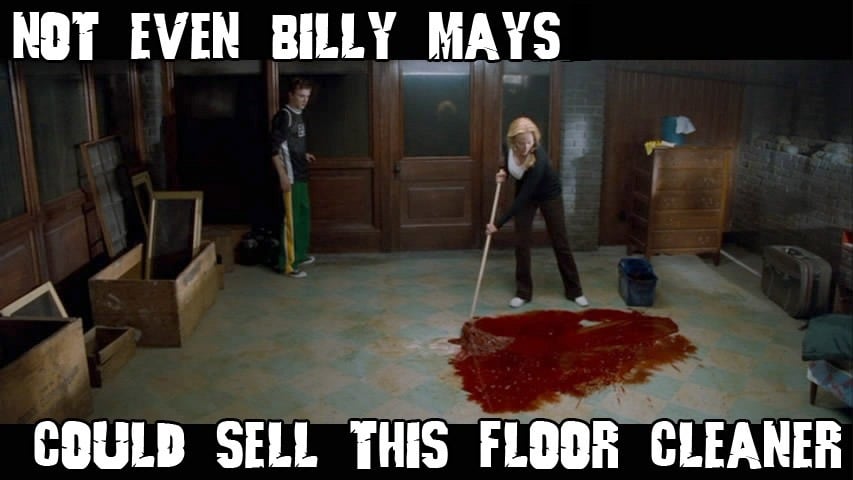
The beginning of the film is rather effective in keeping the audience off-balance, attempting to represent itself as psychological thriller. Initially, the ghostly manifestations are painted in a way that brings the sanity of the near-death son into question. Unfortunately, I cannot help but feel that these interesting attempts at creativity are completely undermined by the film's marketing campaign. The commercials were focused so heavily on special effects and paranormal activity that there was never any doubt that this approach was nothing more than a red herring.
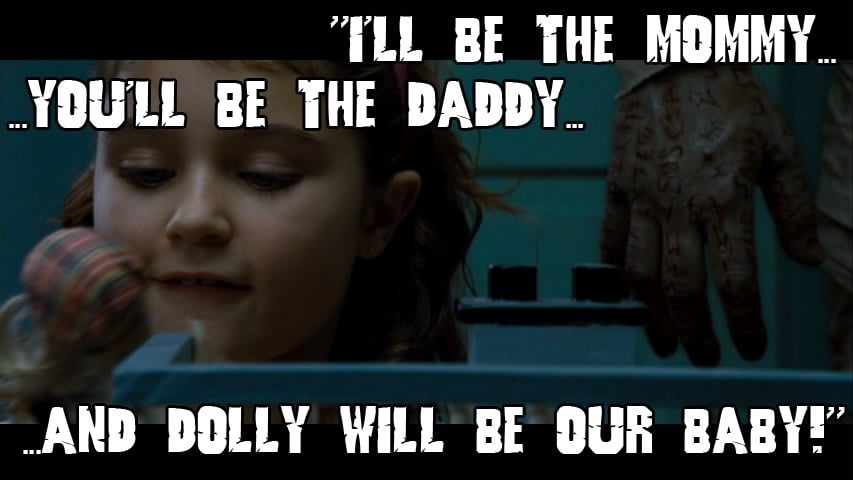
My biggest complaint about this film is how manufactured and forced the entire production feels. This feeling isn't limited to the scares and general horror atmosphere, although it is most noticeable there. For instance, there is a mysterious religious figure with a dark past who has crossed paths with ghosts and demons in unexplained previous encounters. They're trying hard to recall fond memories of Father Merrin from The Exorcist with this character, but never comes off feeling like anything but a rip-off. The writers would have been served the film by introducing characters based on the ghost-hunting husband-wife team of Ed and Lorraine Warren, whom investigated the real case on which the film is based. At the very least this would have changed the dynamic between these deus ex machina, knowledge-possessing characters and our protagonists.
Another aspect of the film that bothered me was the opening sequence, which consists of a short scene where the mother is recounting why the family decided to move into the haunted home. This scene is presented mock-documentary, going so far as to include a boom mic in the camera shot to reinforce how "real" this type of presentation is supposed to feel. Outside of the first two minutes of the film, this particular narrative device is never seen nor referenced again. The exposition delivered here is nothing earth shattering and is all established easily enough in the next few scenes of the movie proper. In the end, this framework feels unnecessary and extraneous to the rest of the film.
Other parts of the movie feel equally uninspired. The subplot regarding the father's alcoholism is predictable and never leads anywhere interesting. It serves a source of tension between the wife and husband, but due to the quality of acting and lack of chemistry between the characters, the audience never really cares about their familial plight. The same goes for the dying son whose condition steadily worsens as the movie goes on. Symbolically, Matt is literally moving towards death's door as he uncovers the history of the house and the spirits contained within. When the climax of the film comes and the house is cleared, it is hardly surprising when it is revealed that Matt has been miraculously cured of his disease. At times the heavy handed scripting in combination with the wooden acting makes this film feel like a larger-budget made-for-TV-movie.
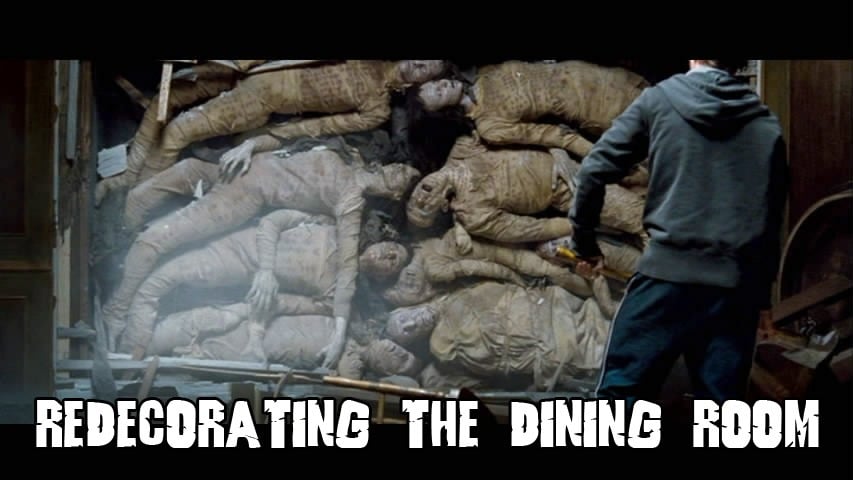
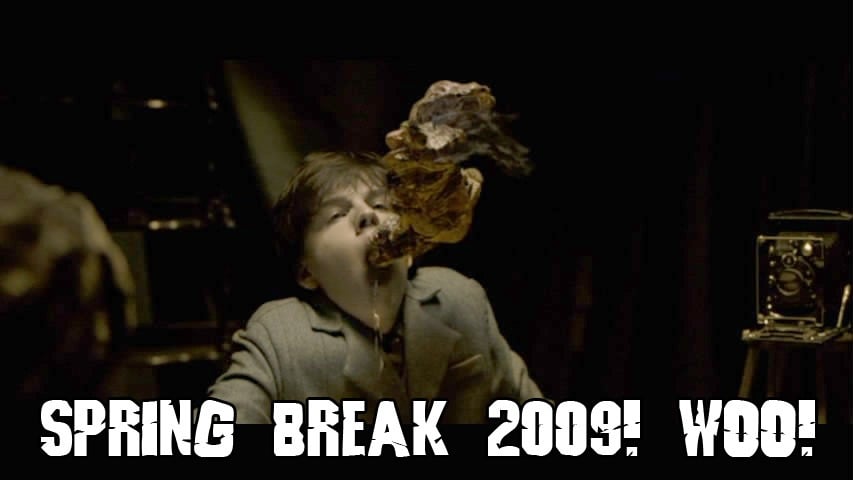
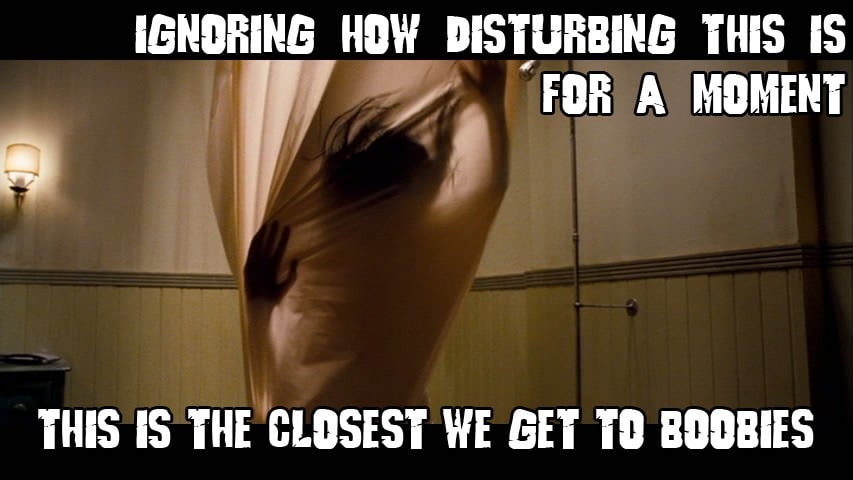
The strongest aspect of The Haunting in Connecticut is the film's striking visuals. The house and the furniture within are suitably old are genuinely creepy, becoming a character in and of themselves. In addition, the CGI effects are put to good use and are effective at generating scares. One scene involving a sinister shower curtain is likely to stick with some viewers even after the end credits roll. Another of my favorite effects are the tendril-like ectoplasm secretions, which are amongst the best visual representations of this phenomenon within recent memory. Finally, some of the ghostly imagery that occurs in the climax of the film is well-beyond what most other horror films in PG-13 territory dare to show. Watching Matt take apart the wall in the family dining room only to reveal dozens of mutilated corpses lining the room is genuinely disturbing imagery.
The Bottomline: The Haunting in Connecticut is a paint-by-the-numbers horror film that has a designed-by-committee feel running throughout its content. The visuals are the one component of the movie where the filmmakers decidedly succeed and the film may be worth a watch if only to view these effects. This isn't a bad film, but there are many better options with similar themes (Poltergeist, The Exorcist).
Three stars.
The kaiju or giant monster genre has been rather stagnant as of late; I don't think I've seen a decent monster movie since Korean film The Host graced the shores of the United States in late 2007. That being the case, when I first saw the initial trailers for today's film Big Man Japan, I was intrigued. A itch that had not been scratched in some time suddenly flared up and demanded satisfaction be rendered unto it. It's been about a year since I first caught wind of this project, and now thanks to a wide DVD release I have been able to partake in its cream-filled goodness.
Big Man Japan is an interesting agglomeration of what might have been several different films. The main portion of the film's first two acts consists of mock-documentary footage featuring an unseen filmmaker and the subject of his work, a seemingly average Japanese man named Dai-Sato. The documentary begins by introducing us to Dai-Sato is employed by the Japanese government. He is the lone employee of a Homeland Defense-like branch of the government. These interview-style scenes are rich with humor that is all delivered completely deadpan. Although this was not a problem for me personally, people who do not appreciate this style of humor may find these scenes slow moving or even boring. This is unfortunate because they make up the bulk of the film's runtime.
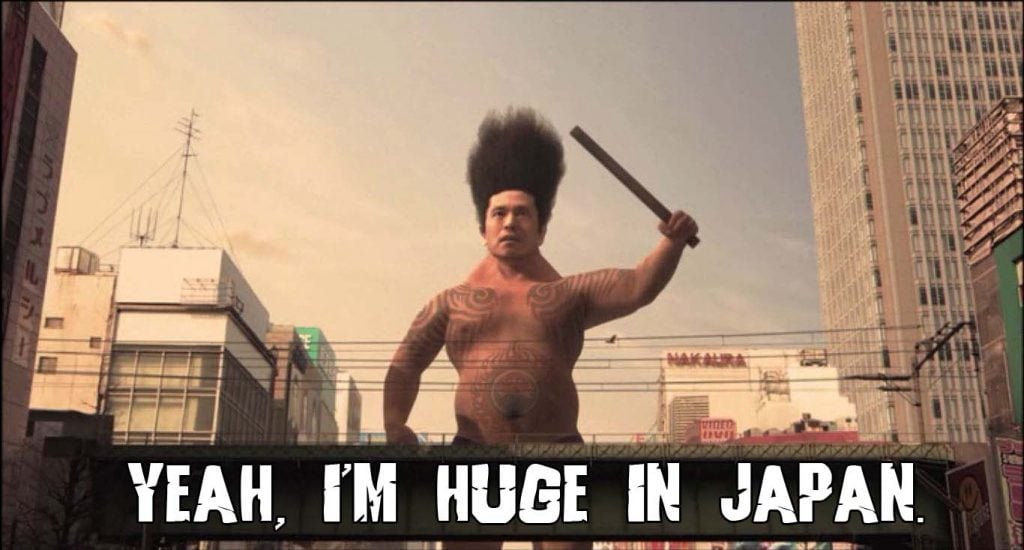
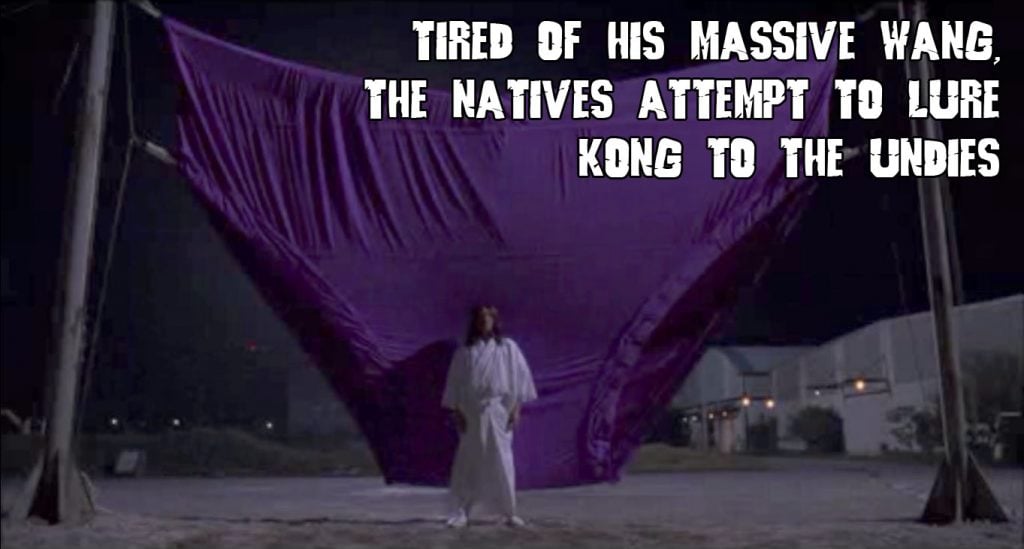
The movie quickly establishes that Dai-Sato does not have a lot going for him in his daily life. He is underpaid, divorced, and seemingly despised by the general public for his job. The exact nature of his work is not immediately revealed but before long a mysterious phone call sends Dai-Sato into action. He rides his scooter down to the local power plant where the film crew is not permited to follow. Although we do not see what happens at the power plant at this time, the effects of what occurs there is immediately apparent. In the next scene, a 30-meter tall Dai-Sato, wearing only a skimpy pair of purple briefs, marches into Tokyo to do battle with a giant monster wrecking havoc there.
Dai-Sato is the heir to the Big Man Japan lineage, the last surviving member of a long line of monster battlers. Like his father and grandfather before him, when a giant kaiju monster attacks Japan, the government calls upon Dai-Sato who grows to gargantuan size to do battle with the aggressor. The process by which Dai-Sato is able to grow in size is revealed to require running high electric current through his body. Humorously, the contact points for the electrical current are Dai-Sato's nipples, which he claims is very important due to their inherent sensitivity!
The monster designs in this film are wildly imaginative. The computer generated effects lend a very unique style to each of the designs which are more visually interesting than any other kaiju in recent memory. Also, because they are completely CGI, the monsters do not have the same motion restrictions as monster designs based on a man in a rubber suit. I only wish this freedom of movement was better capitalized on in the battle sequences and were used to deliver fights unlike anything we've seen before. Instead, most of the fights degenerate in clubbing and various simple wrestling moves. Another interesting facet to the monsters' designs is that most of the monsters have actors' faces superimposed onto them. At first I thought this was an odd artistic choice, but the humor these facial expressions allow for quickly made the choice an agreeable one. The facial expressions of the Leaping Monster in particular made me chuckle aloud on several occasions.

As the movie progresses it becomes readily apparent that the position of being Big Man Japan is not particularly glamorous. There was a time when the Big Man was a much beloved and renowned national figure, but those times have long since past. His grandfather used to fight monsters on prime time television to great acclaim, but due to decreased ratings Dai-Sato is now relegated to late, late night television. Although he performs a very important function in defending Japan from monstrous threats, the public isn't interested in watching an overweight giant wrestle dangerous creatures into submission. In modern times, Big Man Japan has become a joke.

The story of the film begins to pick up when Dai-Sato begins to make a series of poor decisions, including accidentally killing a monstrous yet harmless baby infant. Popular support for the Big Man further dwindles when he is defeated and runs away from a muscular, bright red, devil-like monster. There is some duality to the film's proceedings as Dai-Sato's everyday life deteriorates into depression, even as his public Big Man persona is rendered an ever-greater social outcast. The movie comes to its climax as the Devil Monster again attacks the city and the government has no choice but to call upon the Big Man to defend Japan one final time.
Given that I really enjoyed this movie, I don't want to further spoil the ending or give away any more of the general plot points. Unfortunately, I feel compelled to mention that the final act degenerates in more ways than one. The very final sequence pitting Dai-Sato against the Devil Monster begins with the film's standard CGI effects but then changes to what can only be intentionally-bad rubber suits. The tone of the film also shifts away from the deadpan humor we've grown accustom to and moves more towards heavy-handed, audience winking territory. In regards to the special effects, I would say that it seems like the production simply ran out of money, but the rubber suits and model buildings no doubt cost just as much to build, implying that this change was a creative choice. I understand the intended homage, as rubber suits have long been a steadfast adornment of the kaiju genre, however the changes are jarring given the continuity of the rest of the film. In regards to the comedy, I don't doubt the shift will bring chuckles to some viewers but many others will be left scratching their heads. With the change in tone, the story regarding Dai-Sato's status as a social pariah is discarded and a suitable resolution to that conflict is never presented.

The Bottomline: Big Man Japan is a fun foreign film with some crazy ideas. If you're in the mood for a fun monster romp with some social commentary, this could be just the movie that you're looking for. Unfortunately, a comparatively weak final act prevents this film from attaining the greatness that the setup promises. Still, you've probably never seen a film quite like Big Man Japan. Give it a shot.
Four stars.
Let's be honest for a moment, shall we? Not all movies are born destined to be award-worthy, mainstream material. There are some films that are made for specific purposes and for specific audiences. Figuratively speaking, some books can be judged by their covers. That said, if you're the kind of person who reads the title Sorority Babes in the Slimeball Bowl-O-Rama and doesn't think it would be an experience you would enjoy, then you're probably right. This film is an unapologetic 80's B-movie with super-cheap special effects and enough nudity to ensure that it would only ever be aired during a late, late night time slot on a premium cable station.
The film begins by introducing us to three college nerds whom have overheard the location of the Tri-Delta sorority initiations. Like any male promised a look at boobies, the three plan to spend their evening spying on the scantily clad would-be sorority sisters. Being bumbling fools, the nerds are caught in the midst of their peeping endeavors and forced to accompany the initiates on their final hazing task: to break into the local bowling alley and to steal a trophy to prove they were there. The group picks up a sixth member once they break into the bowling alley, interrupting a robbery by a blonde punk chick named Spider (Linnea Quigley). Things go from bad to worse for our heroes and hoes when the stolen trophy is broken open, releasing a mean-spirited, wish-granting imp.
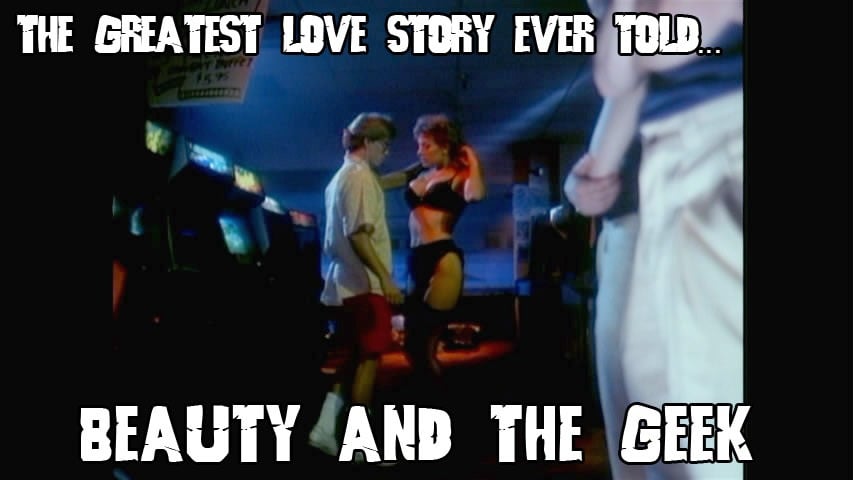
The senior sorority sisters have followed the initiates to the bowling alley, with the intent of scaring the hell out of the newcomers. They witness the initial release and wish-granting by the imp over the security cameras in the bowling alley. The Imp is somehow able to sense their presence, however, and uses his magic to transform them into his mindless minions. As is usually the case in movies like this, the wishes start off good, as intended by the respective wish-maker, but quickly degenerate. Once this happens, the main characters are killed off one-by-one by the Imp's minions. The bulk of the film follows good-hearted nerd Calvin and Spider, both of whom chose not to wish for anything, as they try to escape from the bowling alley with their lives.
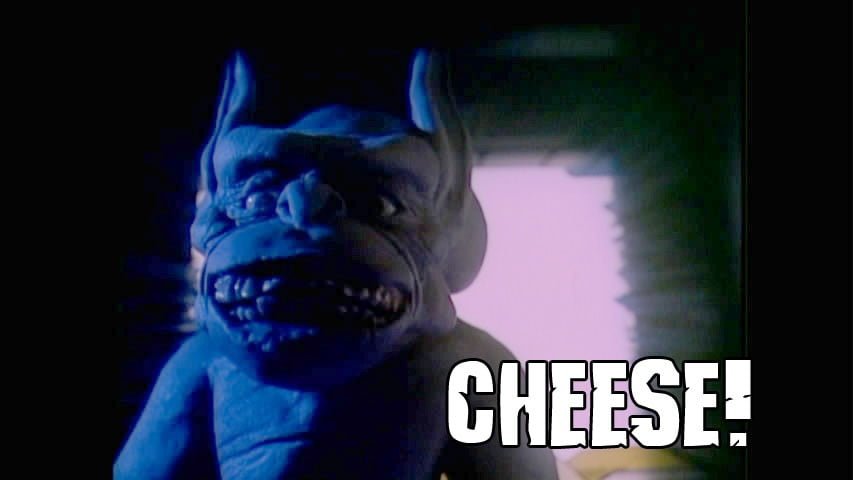
The plot of the film is a fairly imaginative if not quite original creature-flick with ideas far beyond the capability of the special effects on display. The Imp itself is a very rubbery-looking hand puppet of some kind and is always shown either poking around a corner of in extreme closeup. Tight shots like this must have been necessary to keep the puppet operator out of frame but is unfortunate because it reveals the rather poor quality of the puppet itself. I would have definitely welcomed the use of some rudimentary stop-motion to show some pulled-out shots of the Imp walking around the environments. Regardless, the old time specials effects are still more fun to watch than the cheap CGI that might have been used had the film had been made today.
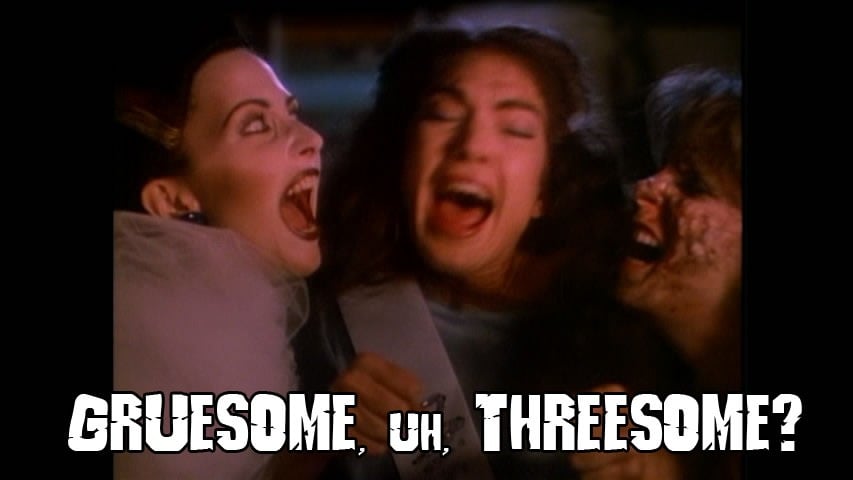
Along the same lines, the make-up effects used for the sorority sisters in their possessed minion states are laughable at best, consisting mainly of a simple costume change to signify their transformation. For some reason, when one of the girls transforms, she become the Bride of Frankenstein although an explanation regarding why this occurs is never provided. Pretty much all of the kills in the film occur at the hands of these human minions, so don't keep your hopes up for any flashy, magic based death sequences. The kills that do occur are at least somewhat varied and original. One death in particular stands out in my mind and involves a character's face making friendly with a deep fryer.
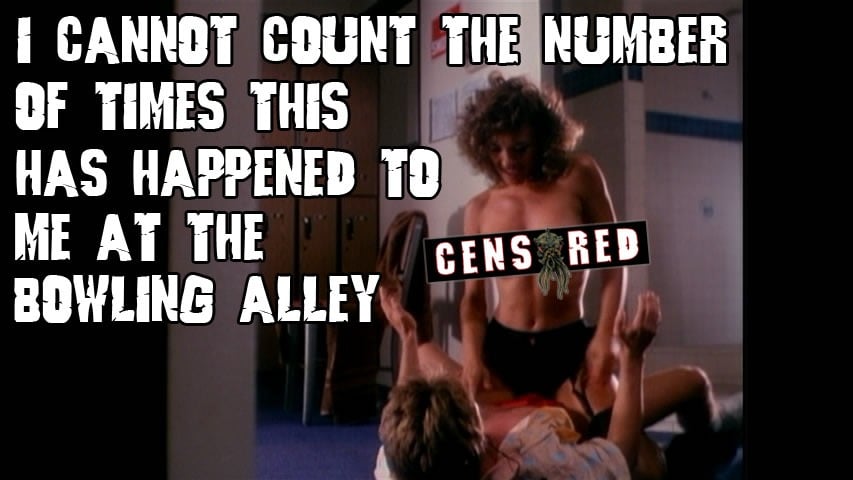
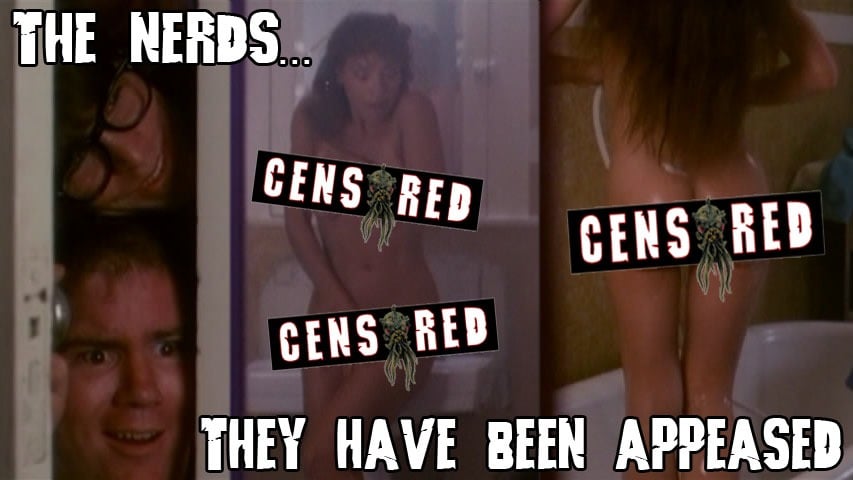
The one thing that this movie has working purely in its favor is its female cast. Sorority Babes has the distinct privilege of being only one of two films to star all three quintessential 1980's B-movie scream queens; Linnea Quigley, Brinke Stevens and Michelle Bauer. That said, there is an abundance of T&A on display in this film, although the majority of it comes from the later two scream queens exclusively. In fact, Linnea Quigley, shows no skin whatsoever. Although Brinke Stevens has some full frontal in the beginning of the film, Michelle Bauer's character, Lisa, seems to be in this movie almost exclusively to be naked. Much to the joy of film geeks everywhere, even once the horror elements of the film kick in, Bauer remains committed to showing off the goods.
The Bottomline: Sorority Babes in the Slimeball Bowl-O-Rama is good, mindless B-movie fun in its purest form. The effects are cheap, the girls are hot, and the movie just plain feels fun. Yes, there is a lot that could have been done to improve some of the technical aspects of this film, but I like it just the way it is.
Four stars.
On this latest stroll through the woods, a group of young delinquents are sent into the titular national park to repay their debt to society. As teased early in the film, each of the characters in Grizzly Park are the perpetrators of some misdemeanor crime for which they are performing community service. The film was released in 2008 and clearly had some budget behind it, as the presentation is unarguably slick for a movie that never saw a wide release prior to the DVD market.
The plot is a mishmash of different ideas, none of which seem to be particularly well developed or concluded by the time the end credits roll. The film begins with a correctional facilities officer on the side of the road, replacing a blown out tire on his van. A serial killer, Butch, whom has just escaped from a local prison, comes across the officer and promptly does him in, stealing the officer's uniform and the van. Then, instead of taking the van and making for Canada, Butch inexplicably decides to stick to the dead officer's appointments and makes his way down to the local county police station to pick up his young charges.
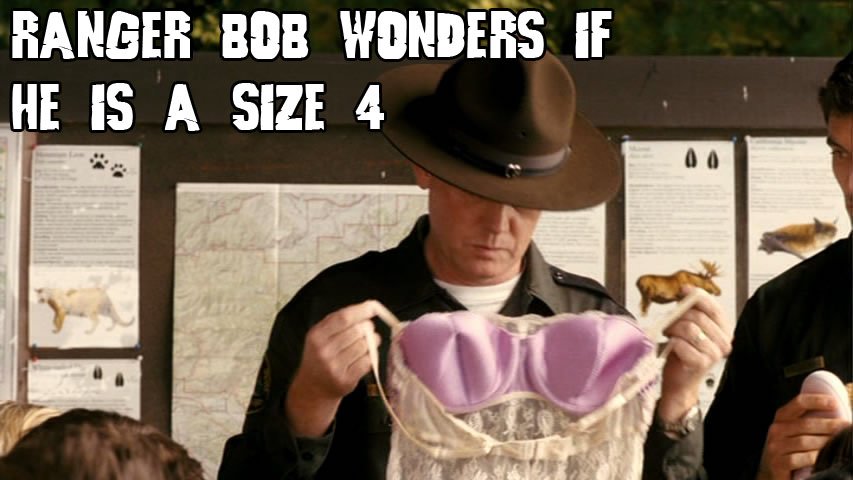
Butch follows along with the plan for awhile, taking the group of felons up to the ranger station at Grizzly Park where they meet the local forest rangers, Bob and Michael. Ranger Bob (Glenn Morshower) has the singular and unenviable pleasure of leading the group into the woods for the weekend and that Ranger Mike is going to stay back at the Ranger Station should the group need to radio back for anything. This is a good plan until Ranger Bob and the criminals leave and Butch messily dispatches poor, handsome Ranger Mike. Butch himself then takes to the woods, with the intention of intercepting and dispatching the rest of the characters at the cabin at the top of the mountain.
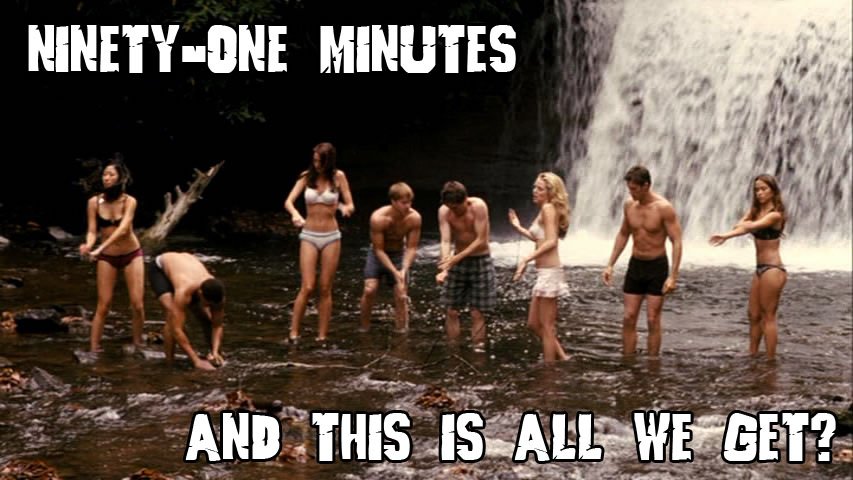
The plan seems to be going swimmingly for our good slasher friend until a giant grizzly bear catches the scent of his blood stained uniform. With only his switch blade to defend himself with, things don't turn out well for old Butch. This scene takes place at the 40 minute mark in the film and is representative of the film's foremost problem; it seems that even through the scripting stage the writers didn't know what they wanted this movie to be. The previous 40 minutes of the film have been your normal, run of the mill slasher film with a decidedly human adversary and now the role of the film's antagonist is suddenly transferred to this grizzly bear, a force of nature. It's almost like two halves of two different films were taken and stitched together with a common cast of victims. The two halves never seem unified and are certainly not helped by an ambiguous ending scene seemingly tacked on during the final moments.
The problems with the script are not relegated to the dichotomy of the plot. The various characters making up the group of youthful law offenders are almost all unlikable and, over the course of the film, most are all revealed to be guilty of crimes that reach rather far beyond their surface misdemeanors. None of the characters seem to appreciate the beauty of the national park and, despite Ranger Bob's best attempts, none seem to be using their community service time to reflect back on their own misdeeds. Neither the prostitute willing to do it all for Coach bags and Gucci shoes, nor the rich frat guy into auto-erotic asphyxiation and 15 year old girls seem to have any intention of using this time to properly repent their sins. None of these young characters are likable, with the sole exception of the sweet but ditzy brunette, Bebe (Emily Foxler).
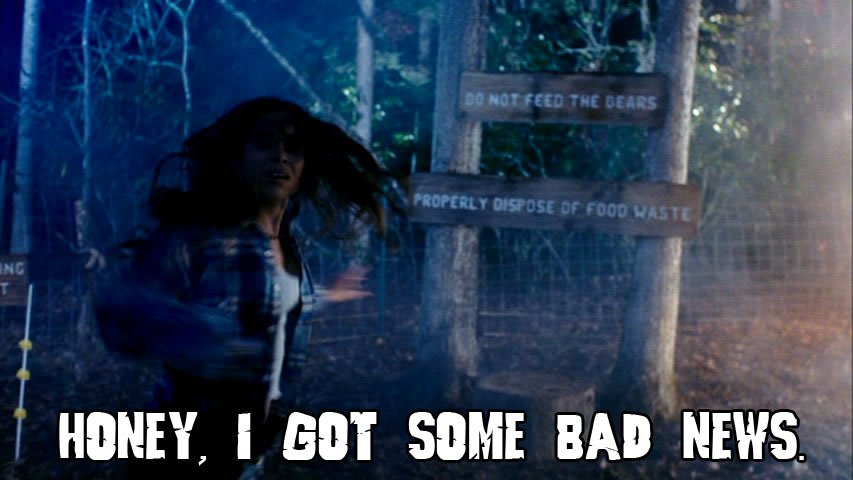
For a film filled almost entirely with fodder, it takes entirely too much of the film's 91 minute runtime for the first of these characters to meet their maker. Not counting Butch's victims, the first death disappointingly clocks in somewhere around the 57-minute mark and takes place mostly off-camera. Also indicative of further scripting problems, much of the dialogue is inane back and forth between two-dimensional characters whom seem to only be interested in their assigned vices. It says a lot when your most complex character is a gasoline-huffing white supremacist who experiences conflicted emotions about his boner for the Latina gang-banger.
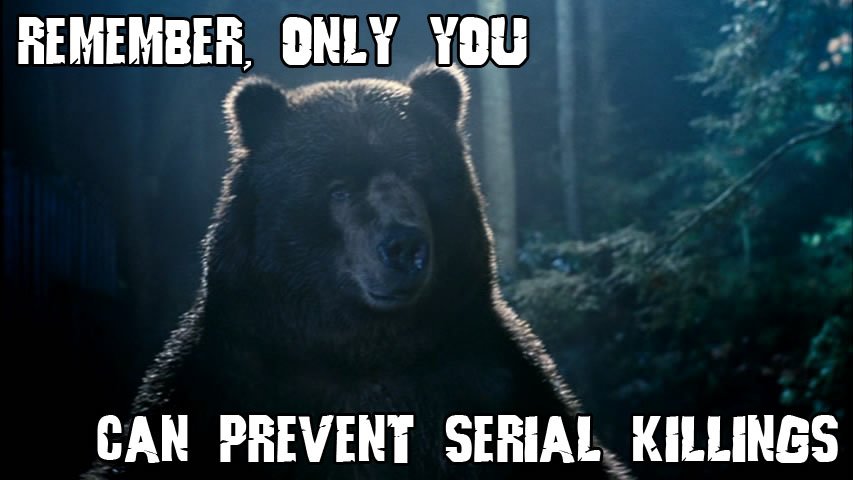
Despite all of these remarks, there are parts of Grizzly Park to recommend. First time writer/director Tom Skull has shown quite a bit of skill for his first project, particularly in regards to the presentation and cinematography. Once the final act begins and the blood begins to flow, the remaining twenty minutes of the film contain a good deal of manic, B-movie fun. A few of the deaths in this last sequence are hilariously over-the-top, including one kill that sees a breast implant ripped out and popped against a tree like a water balloon. Some of the cheap special effects also help maintain that fun B-movie feel, like the clearly fake prop bear arms that aroused a chuckle from me on several occasions. Speaking of which, an actual Kodiak grizzly bear, Brody, was used to film the live-action bear scenes peppered throughout the film. Brody gives a good performance but, based on the editing, it seems he was never actually on set with any of the actors during filming.
The Bottomline: Grizzly Park is an average B-movie that takes entirely too long to get to the pay off. The first half suffers from an identity crisis, not clearly defining itself as a slasher or man-against-nature flick. Shallow characters and a poorly executed ending also mar the experience. Still, if you're in the mood for some hot man-on-bear action, you might do worse than this.
Two stars.
Released in 2002, Camp Utopia is a low budget slasher film centered around a group of five teens on a camping trip. The movie begins with a flashback, laying the ground work for the history of the the titular camping grounds. The name Camp Utopia refers to a hippie commune that existed somewhere in the backwoods of California during the 1960's. Their free-love community was led by a Manson-like, former rock star named Timothy Bach (played by Ratt frontman, Stephen Pearcy). Together, they all lived at Camp Utopia as a group of free spirits, reveling in a culture with its foundations firmly rooted in the indulgences of sex, alcohol, and pills.
As the legend goes, Bach takes a hit of some bad acid one night, prompting him to embark on a murderous rampage. His first victim is a random hippie girl with whom he was engaged in the physical act of expressing one's love for another. Ahem. Sex. The way the scene is presented, I'm not sure if it was truly the bad acid that caused Bach to lop off her head with a machete; it may have been the fact that, by all accounts, she was merely a lousy lay. At any rate, the killings don't end with the girl, as Bach takes the machete (and her head) back to the camp proper and hacks up the majority of his followers. After he's done, Bach takes his head and machete and disappears into the woods. NEVER TO BE SEEN AGAIN!!
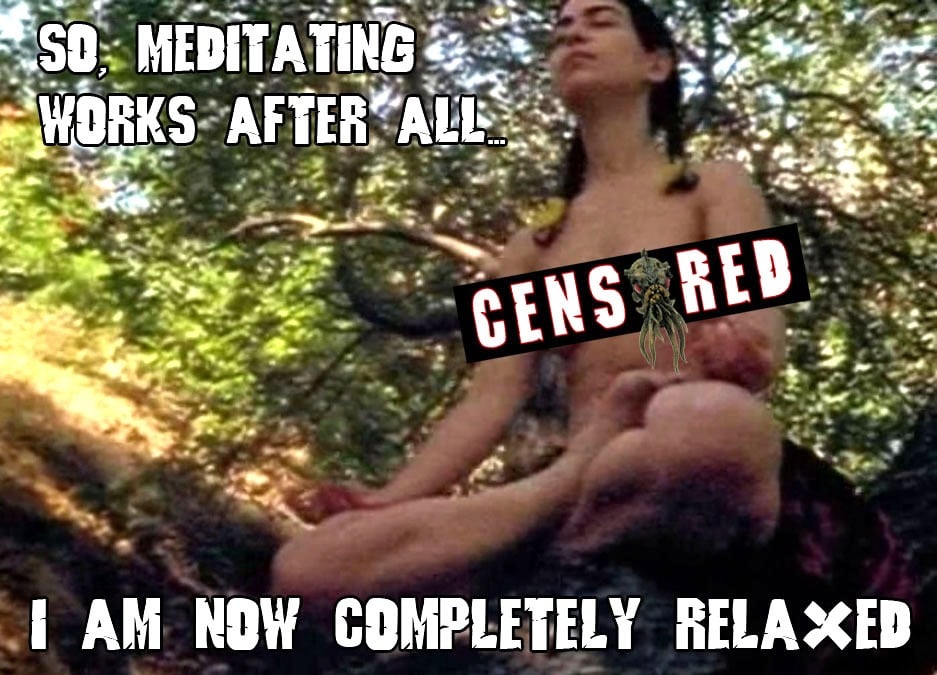
Cut to present day and we meet a whole bunch of really unlikable guys driving around in a van. Although you would probably never guess, they're all supposed to be in high school. In addition, they're apparently all Wall Street prodigies because they talk at great lengths about day trading, and how awesome day trading is, and how much money they've made from day trading, and how you should buy low and sell high when you're day trading, and how they're not going to go to college because they make so much money day trading.
Yeah, the dialogue is kind of like that.
Did I mention day trading is a recurring topic of conversation throughout the film. Yeah. To be fair, there's actually two topics of conversation that the guy characters in this film alternate between: day trading and sex. The female character's dialogue isn't much better, as their choice of topics seems to switch back and forth between being catty bitches and sex. Now I know what you're thinking; isn't this a horror movie cliche that, being the B-Movie Geek, I should be rejoicing and celebrating over? While the short answer is yes, I much prefer everything in moderation. When your characters are incapable of broaching any subjects other than those centered around the penis and the vagina it starts to get a bit tedious for the audience. After about five minutes I get it. They're teenagers. They like sex. Let's move on, shall we?

As it turns out our Wall Street prodigies are picking up their twenty-five-year-old high school girlfriends to go on a camping trip because... because... daytrading? In addition to the two couples, a third female, whom has only just moved into town, is going to tag along with the group for the weekend. The guys allow this because the New Girl is hot and they think they each have chances at having a threesome. The girls allow it because... daytrading?
The lead female character, Bitchy Cheerleader (Jessica Jordan), decides to enforce a strict no cell phone policy on the trip in order to distract the guys from their stocks long enough to sex the girls up. As if that were really going to be a problem for this particular group of characters. This, of course, conveniently places the group in the middle of nowhere with no way of contacting the outside world for help. Really quite brilliant when you're heading out to the cursed camp grounds of a legendary mass murderer whose body has never been found.
Oh yes, did I mention that the kids are quite aware of the tales of the Camp Utopia bloodshed? Well, they are! Their first night in the woods the lead male, Bizzaro Kevin Bacon (Collin Stark), relates the tale of the massacre to the others as the sit around the campfire. From a story perspective, this sequence is meant to inform the New Girl character of the local legends. From a filmmaking perspective, this sequence is meant to inform the audience of the local legends. The only problem is, they already showed us everything that happened in the flashback sequence that opened the film. Even worse, all the footage they use to overlay the campfire story is take directly from that flashback sequence. Oh joy, the filmmakers get to pad out their hour and twenty minute run-time by showing me the same footage twice!
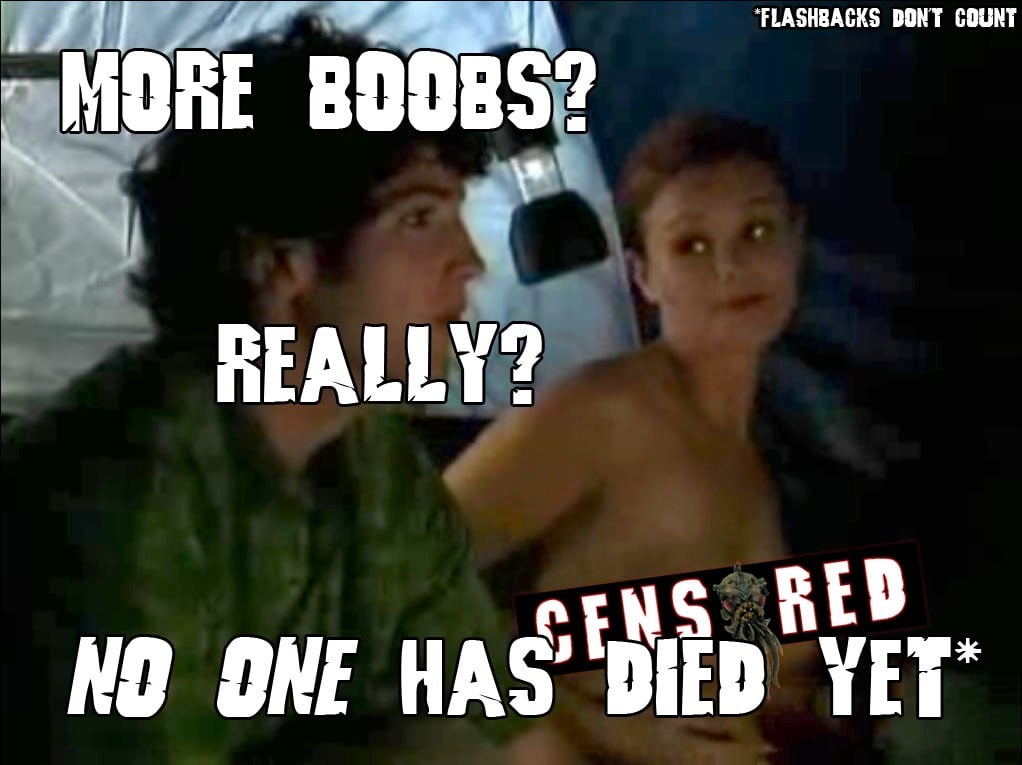
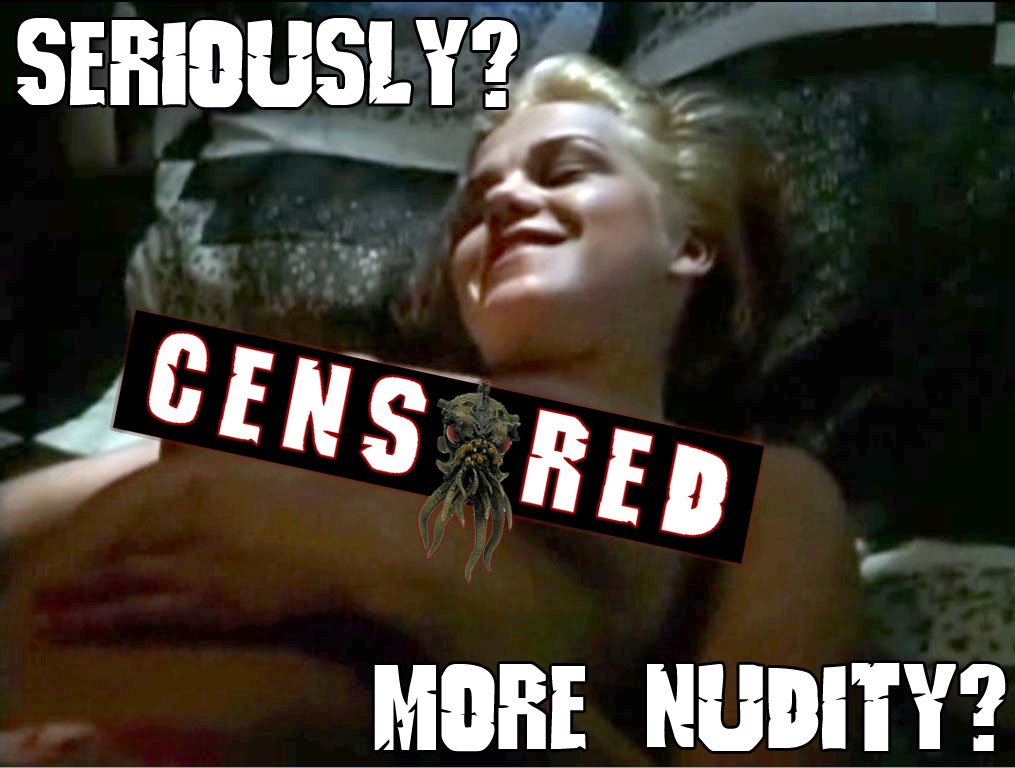
The tempo of the film is also a bit off from your typical low budget slasher. Very little time is spent on the kills or the sequences leading up to them. Outside of the flashback at the beginning, there are no deaths until over forty minutes into the film. Instead, the audience is treated to rather surprising amount of nudity from the relatively small, unknown female cast. There's nothing that particularly stands out about any of the nude sequence except for the sheer number of them. Almost all of the female actresses in the film go topless at one point or another. I'm not exactly complaining, but it seems like the nudity is just there to help pass the time until something actually happens.
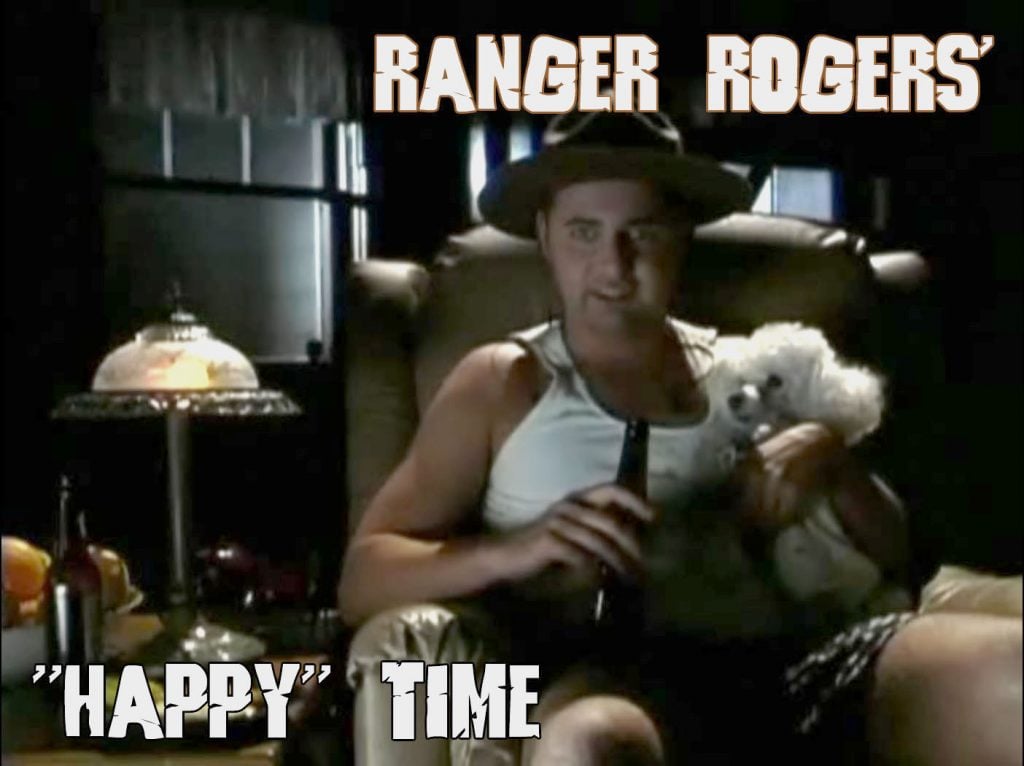
As hard as I'm being on this film, there's actually quite a bit here to like. While I'd have preferred that the characters had been less two dimensional, this is a fault of the writing not the actors. All of the acting in Camp Utopia is actually pretty good for a film of this type. The comic relief character, Ranger Rogers, is a bit over the top, but is played well by Adam Minarovich. His humorous and lecherous antics serve well to identify him as the Red Herring of the proceedings. New Girl (Alexandra Westmore) in particular does a commendable job with some of her later scenes that might have come off much hokier if not for her performance. While I may not have been impressed with the dialogue, the writing involving the story does eventually do some interesting things as well, which I won't spoil here. Let's just say that the sequence in which the Last Girl discovers who the Slasher is (the identity of whom is telegraphed a bit much for my liking) plays out like it usually does, but then we get another fifteen minutes of story that also happen to the film's strongest. Although there's nothing unpredictable or particularly original in the content of this last section of the film, the writers deserve mention for following a story path that I didn't expect them to take.
The Bottomline: Camp Utopia is a solid low-budget title that will appease most fans of the horror and exploitation genres. The movie suffers from poor dialogue and timing issues, but still manages to be enjoyable. If you like direct-to-video titles, you might do well to give Camp Utopia a look.
Three stars.
Dark Woods (2006) is a low budget, independent movie filmed and released back in 2006. The movie was directed by Jake Daniels and is one of only two credits attributed to his name. The general quality of low budget filmmaking does not get much lower than that on display in this film during its relatively short 75 minute runtime. I can't say with any certainty how much money was spent on the production of this film but I would hazard a guess that the number does not exceed $10,000 and is likely much, much less.
I know that a leading paragraph like that doesn't do much to paint Dark Woods in a positive light, but let me confess that I don't mean for it to sound negative. I just want to be upfront about the kind of movie we're talking about. This is not a Hollywood picture by any definition of the phrase and your expectations should be adjusted accordingly. As easy as it might be to trash the technical components of this movie and call it a day, I must confess that I still enjoyed watching Dark Woods. The film ignited a strong feelings of nostalgia within me, particularly reminding me of low budget 80's slashers from my childhood.

This brings us to the movie's strongest point; the people in charge of making this film were clearly very passionate about the genre. There are so many tips of the hat towards a variety of popular 1980's horror franchises that the nods almost cease to be subtle. The cook, for instance, is an older blonde woman by the name of Pamela, which I took to be a reference to Friday the 13th's Mrs. Voorhees. Even the physical similarity between the actress and Betsy Palmer is rather striking. Along the same lines, the last girl is a young, fresh-faced brunette by the name of Heather, referring to Heather Lagenkamp, the actress that played Nancy in A Nightmare on Elm Street.

The homages present in Dark Woods does not end with the names of its characters. The plot of the film revolves around a group of teenage camp counselors whom have come together to finish preparing Camp Vernon for the upcoming season. The teens succumb to the usual stock of horror-cliche, young people vices and are picked off one by one by a machete-wielding, hockey mask-wearing backwoods maniac named Victor. It would be easy to interpret the plot of the film as entering into Friday the 13th rip-off territory; the filmmakers even include a soothsayer character along the lines of Crazy Ralph, here creatively dubbedMad Max, to inform the kids of their impending doom. So there I was, about twenty minutes into the film, just about ready to write the film off entirely when the filmmakers did something that surprised me. Instead of merely copying Friday the 13th, but the filmmakers began to take some of those basic elements and expanded on them in new and interesting ways.

It should come as no surprise given her name and physical similarities that Pamela actually has ties with the masked murderer, Victor. There is a bit of a shift in the relationship however, as Pamela was once Victor's lover and, thankfully, not his mother. Although it never become perfectly clear, it seems that Victor's murderous rampage is somehow motivated by his desire to win back Pamela's good graces. This relationship represents a deviation from the formula, certainly, but in the end is really rather uninspired.

The interesting expansion of ideas that I had previously mentioned can largely be embodied in the soothsayer character, Mad Max. Much like Crazy Ralph, Max turns up early in the movie and warns the teenagers of their impending doom and serves the function of a red herring. Unlike Crazy Ralph whom promptly disappears from the rest of the proceedings, Max becomes a recurring character. As the movie unfolds it becomes increasingly obvious that Mad Max is not only eccentric, he's actually quite twisted. Before long it is revealed that Mad Max is actually helping Victor by spying on the counselors and reporting back to him on their whereabouts and activities. Turns out, Mad Max is an old Vietnam War buddy of Victor's and goes so far as to carry out some killings himself. Admittedly there's nothing earth-shattering about this scripting but the fact remains that this is not a character relationship that I've seen in a movie of this genre before. The filmmakers deserve credit for creativity.

Based on the picture and sound quality, I'm guessing that Dark Woods was filmed on a VHS camcorder with only a single microphone. I'm not sure that there was any real lighting to speak of on the set. Almost all of the kills happen off-screen with only a quick cut back to the dead body showing the actors sporting what is clearly a cheap make-up shop latex appliance. Tom Savini this is not. On the other side of the quality spectrum, all of the actors performed quite admirably for a group of complete amateurs. With the only exceptions being limited to single scenes, they all manage to avoid fulfilling the overacting, annoying stereotype that commonly graces such low budget fare. Kudos to you all.
The Bottomline: Dark Woods is the definition of low budget filmmaking. Due to the technical limitations, I cannot recommend this film to people who only casually dip into the direct-to-video movie market scene. That does not mean that there isn't anything here to like. If you are a devoted fan of Grade-Z cinema, then this one is definitely worth a look. It is currently available to rent on Netflix.
Two stars.
For too long the Hollywood machine has churned out crappy horror movie after crappy horror movie, with sequels and remakes being the theme of the day. The last few years have seen more PG-13, pointless, blood and nudity-free, soft horror films than ever before. The Texas Chainsaw Massacre remake and subsequent sequel were terrible. The remake of The Fog was a bore. Hostel and Hostel 2, while R-rated, were plot-less, derivative drivel lacking any remotely likable characters. The Eye, The Grudge, The Ring: all Americanized, spiritless, lesser versions of the original imports.
We need Old-School American Horror.
Enter Hatchet.
In my previous preview leading up the release of Hatchet, I wrongfully assumed that this movie was going to amount to a quick and dirty ripoff of Friday the 13th. A good deal of the buzz surrounding this film has revolved around the fact that the titular weapon-wielding maniac would be played by longtime fan-favorite Kane Hodder. For those not in the know, Kane played Jason Voorhees in Friday the 13th VII and onwards and is considered by many to be the ultimate incarnation of that character. While the lead up to Hatchet played upon this connection and did its best to make its villain look and sound like Jason, Victor Crowley is an entirely different blood-crazed freak.

The plot of Hatchet see a group of three male, college friends seeking to take a temporary break from the constant barrage of booze and boobs of Mardi Gras to take a haunted swamp tour. Additional members of the tour group include the Asian American tour guide, an older husband and wife tourist couple, a seedy softcore porn director and his two "actresses," and finally the girl with a mysterious past. The tour takes a turn for the worse when the boat runs aground and they get stranded out in the middle of the bayou. Things go from bad to even worse when the groups happens upon the ghostly yet physical manifestation of Victor Crowley's childhood home.

The biggest complaint I have with the film is that the real star, Victor Crowley, is essentially a complete non-entity until the final thirty minutes. It's "The Jaws Effect" where the director tries to build suspense with the audience by keeping the monster off screen until the big, dramatic reveal. Unfortunately, I don't feel that this approach works for Hatchet. As the movie progresses through its first two acts the audience receives only a small handful of half glimpses of Victor but fails to build suspense leading up to the reveal. I acknowledge what the director, Adam Green, was trying to do but when the moment of revelation does finally come, it feels like too little too late.

Luckily for the film, from the moment of Victor's arrival to the rolling of the end credits, Hatchet becomes a horror-themed roller coaster ride of epic proportions. Victor Crowley is simply the coolest slasher personification to emerge in the last decade of genre films. The makeup effects that transform Kane Hodder into Victor Crowley are top-notch work that even Tom Savini would be proud of. Hodder does a fantastic job in his portrayal of the monster, producing a horror icon that behaves like none that have come before. Where Jason was slow and deliberate, Victor is quick and spontaneous. He's constantly moving and thrashing his arms, resembling a rapid animal more than a man. The Crowley character is Kane Hodder's raged-out Jason, taken to the next level. Really, it's quite glorious.

Hatchet is one hell of a violent movie. The blood runs free and there's plenty of mean-spirited, nasty deaths. The nice thing about the film is that the violence knows it's over the top. While there's no overtly deliberate audience winking, the movie knows it's supposed to be delivering a good time and never takes itself too seriously. In addition, I challenge anyone to find a kill in any of the Friday movies that can hold a candle to the death of Mrs. Permatteo. The creativity on display from the filmmakers is nothing short of remarkable. Adam Green's finger is directly over the pulse of what old school horror hounds crave.
I mentioned earlier that the movie takes too long setting itself up. While this is true, there is good news to be had. While those early 45 minutes spend too much time focusing on character development, these scenes still manage to be righteously entertaining. The movie has a defined sense of humor and the actors perfectly suited to making sure that the jokes are legitimately funny. The frequent bursts of humor help the action stay lively despite the lack of bloodshed. It also bears to be mentioned that genre veterans Tony Todd and Robert Englund also make cameo appearances. Englund in particular is a geek's dream. This may be the closest that we ever get to seeing the real Freddy and the real Jason duke it out, even if Englund's death does occur off-screen.

Now for my biggest complaint, which isn't about the movie itself: This movie is a blood-soaked, over-the-top thrill ride that DEMANDS to be viewed in a sold out movie theater. The fact that this film did not receive a wide-theatrical release is a downright travesty. Hatchet needs to be seen with a rowdy crowd, one where everyone knows the right time to scream, to yell, and to throw popcorn at the screen. Shame on you for denying me that experience, Hollywood
The Bottomline: If you're a horror fan, check this movie out. preferably with a large group of friends. Pop corn is a must. Writer/Director Adam Green will go places in this genre if he wants to, and I hope he will. I'd love to see a Hatchet 2, especially in the theaters.
Four stars.
I've been looking forward to this film for sometime now. I live in an area where its hard to catch films that only play at festivals and/or have limited theatrical runs, so I almost always have to wait for DVD before checking out the newest indie-darlings. I spend a lot of time getting built up on these films although I do my best to avoid any hype or reviews. About the only exposure I give myself to these types of films are the IMDB plot synopsis, a quick glance at the poster, and watching any sort of trailer made officially available.
With that said, from the moment I saw the Jack Brooks: Monster Slayer trailer (long before I actually posted it on this blog), I've been looking forward to seeing it. The makeup and practical effects previewed in the trailer harken back to an earlier time in horror cinema history. And the fact that the story and the lead character reminds me of Evil Dead 2 and Ash doesn't hurt its first impressions either.
So, was 'Jack Brooks: Monster Slayer' any good?
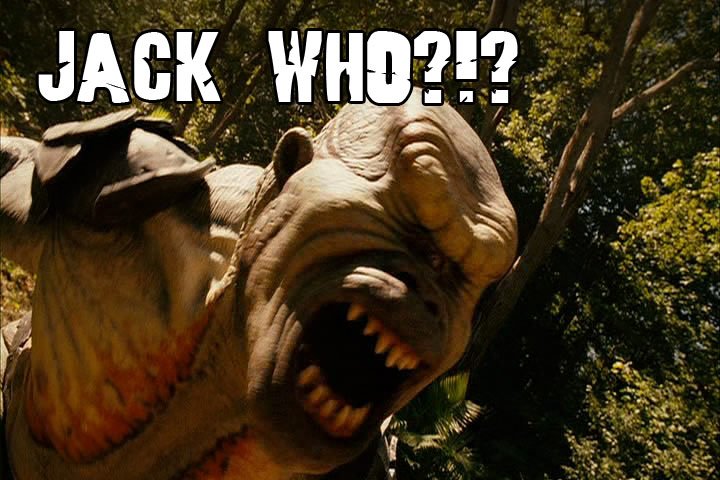
The film has some faults, so I'll address them right away. Some of the special effects, being practical, look like puppets. This didn't bother me but I can see how other might find fault in it. I like old '50s style monster mashes and these effects feed into that nostalgic side of me. The movie also suffers from questionable pacing in the first two acts. The movie starts with a fun but short monster sequence, then goes into some rather lengthy exposition. To the movie's credit, these scenes are punctuated with some short monster sequences which definitely served to whet my appetite for the mayhem to come.

Although the first 45 minutes are slow, they are not without merit. Trevor Matthews stars in his first feature film as the protagonist, Jack Brooks. His performance is nuanced and fun to watch. He does not fall into any of the traps first time actors always seem to in low budget debuts. He is not overacting and he's definitley doing more than just reading words off the page. He loves the material and is having fun with the character. The audience cannot help but like the flawed Jack and root for him despite the many number of poor choices he seems to continually make.

Speaking of having fun with a role, Robert Englund (of Nightmare on Elm Street fame) co-stars as a night class science professor with an unfortunate case of demonic possession. The professor character is slowly losing control of his mental and physical capacities and Englund gives a thoroughly frenetic performance. This is not the ridiculous, melodramatic, almost unwatchable Englund we've seen in other recent low budget fare. Here, the madness is focused and Englund delivers one of his better performance in years.

The movie quickly ramps up in the third act, providing a most satisfactory climax. The monster mayhem consists of equal parts special effects, cheese and slapstick; just how I like it. Some of the scripting is especially inspired; I was especially fond of how the filmmakers creatively explained Jack's ability to transform into a monster slaying ass-kicker by the channeling of his anger management issues in new found physical prowess. This provides depth to Jack's character that would not be present otherwise.
The Bottomline: Jack Brooks: Monster Slayer is some of the most fun I've had with a monster movie in recent years. Despite a slow build, the action and cheese are available with abundance. The practical-style special effects make for a refreshing experience that too often seems to get lost in the modern day push for cheaper CGI effects.
Four stars.